Thursday, December 24, 2015

There are two faces to DH, are you in or are you out?

I've come to the conclusion that DH has two main faces: one is that assumption that many of us made all along, an application of computational and technological methods to humanities research. The other is a social movement that embraces technology and the digital as a medium for change, something that embraces diversity and is humanitarian in nature. It is not always easy to discern which face of DH a project or person is presenting (though sometimes it is) and projects can easily overlap into both.

I was not aware of that second face when I came into this program, but it has captured me. The problem I'm having now is wondering if academia, or even alt-academia, is a place where that version of DH is most effective. I believe that academia and the humanities are capable of generating change, that the education of individuals is a way of promoting change. I also believe that the 'DH wave' is cresting and that if one wants to effect real change while this movement/methodology is at its peak then traditional academic avenues may not be fast-acting enough because, as transformative and powerful a force academia and education can be, it is slow to move (I still think Tolkien had academia in mind when he made the Ents).
(Source)
(Source)


I think that many of us have a desire to change the world at a young age. As time goes on we bring that desire down to a more manageable aim of doing some good in the time that we have. The second face of DH has fanned my flames to the point where I'm back (at least for the moment) to harbouring that somewhat childish desire. The only problem is that I'm not sure DH and academia are a place where I'll be able to implement that desire most effectively due to its slow nature.

Maybe academia wouldn't benefit from another white, male voice as much as it might from say, a female, Hispanic one (though I feel like I might have one or two valuable things to contribute)?

(Source)
Or maybe an even greater selfishness would be for a person to demand to be a part of a movement in which he or she saw immediate results, or even results in one's own lifetime? Perhaps academia and education, despite its plodding course, is exactly where a person who wants to create change should be if he or she are willing to stomach the fact that the change might not materialize within their lifetime.

Julian H. Lewis
Julian H. Lewis, first African American professor at the University of Chicago, 1923. This person published a book in 1942 that (as I understand it) debunked eugenics entirely.

I'm not entirely sure which is the best course of action. I know that I'm committed to the second face of DH at this point. I want to use technology to improve the world, whether that means integrating tech into an academic setting or something as simple as using it to tell stories that embrace diversity (like this, some of these, and this).

In short, I'm in.

Monday, December 7, 2015

What do Games in Learning Look Like?


Brendan raised a really good criticism this week about how both gamification and edutainment fall flat. I agree completely and in the discussion I pointed out that I don't even like the gamification in games let alone seeing it in other places. It actually irks me a little that this process is referred to as 'gamification' and I think the further away from that term games can move, the better.


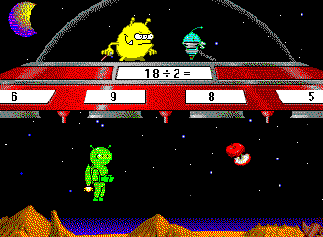
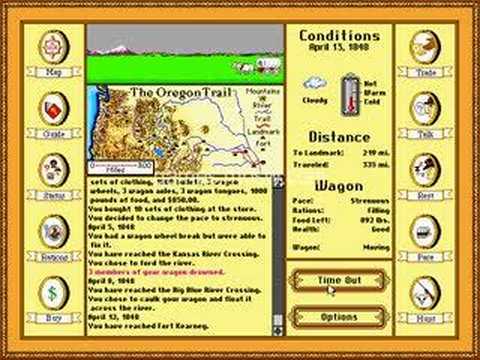
Two of the Best Examples of Edutainment Ever, Math Blaster and Oregon Trail, Though I would Argue the Latter is Actually a Pretty Good Example of Learning through Games

As far as I can see then, there are two solutions: the 'Edufication of Games' and 'Learning through Games':

The first is my own term and what Brendan praised in the form of the Clash of Clans clone used in the study documented by Preist and Jones. Basically, it makes the learning portion part of maintaining the Flow whilst keeping the game itself separate. In this way a student is encouraged to do their studies and the reward is the gameplay or resources within the game. There are obvious issues with how one weights gameplay time with learning time but this is ultimately limited in its scope. It not only creates an environment that requires extrinsic motivation for learning but disjointedly removes learning from games to a point similar to "I'll play one turn of Civ after each essay." This is hardly ideal to me (I don't think it is the most effective means of learning and it can be integrated in less deceptive ways).


The second is something that Richard Van Eck addresses in his paper. For anything beyond memory based learning or extended systems, I would recommend learning through games. This is more than edutainment, it's a form of holistic learning. I can distinctly remember that the first complex piece of literature I ever read was Final Fantasy VII. The sci-fi theme addresses issues of technology and the environment that is on par with anything I've read since. More overt examples that deal with different subjects are games like Quintus's favourite, Masters of the Universe and The Incredible Machine for physics , Rollercoaster Tycoon and other simulation games for business management, the Democracy series for political theory (a game that demonstrates the complexities of practicing politics), and Spore for biology (though I admit it has its flaws, including gameplay that lacks depth), and Burger Tycoon (a game that is free, over a decade old, and addresses how the fast food system has longstanding impacts).

In order to learn through games we need to be able to look at systems critically and be smart readers. It's true that the medium can have difficulty expressing certain subjects but that's true of all media. It just means that we need to get creative about how we use games as a teaching tool.

What are some great games from your past that taught you something, forced you to think creatively through puzzles or the like, or had great stories that caused you to reflect?