Brendan raised a really good criticism this week about how both gamification and edutainment fall flat. I agree completely and in the discussion I pointed out that I don't even like the gamification in games let alone seeing it in other places. It actually irks me a little that this process is referred to as 'gamification' and I think the further away from that term games can move, the better.
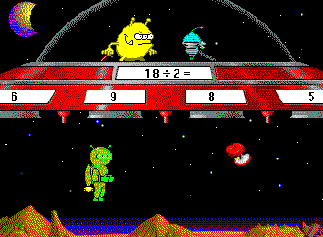
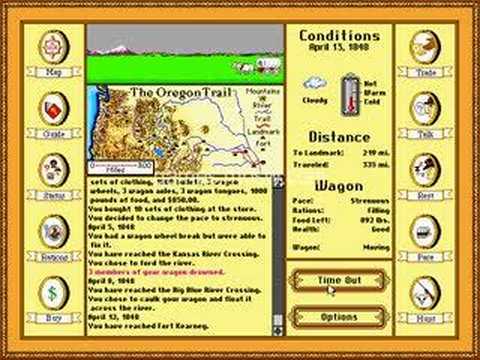
Two of the Best Examples of Edutainment Ever, Math Blaster and Oregon Trail, Though I would Argue the Latter is Actually a Pretty Good Example of Learning through Games
As far as I can see then, there are two solutions: the 'Edufication of Games' and 'Learning through Games':
 The first is my own term and what Brendan praised in the form of the Clash of Clans clone used in the study documented by Preist and Jones. Basically, it makes the learning portion part of maintaining the Flow whilst keeping the game itself separate. In this way a student is encouraged to do their studies and the reward is the gameplay or resources within the game. There are obvious issues with how one weights gameplay time with learning time but this is ultimately limited in its scope. It not only creates an environment that requires extrinsic motivation for learning but disjointedly removes learning from games to a point similar to "I'll play one turn of Civ after each essay." This is hardly ideal to me (I don't think it is the most effective means of learning and it can be integrated in less deceptive ways).
The second is something that Richard Van Eck addresses in his paper. For anything beyond memory based learning or extended systems, I would recommend learning through games. This is more than edutainment, it's a form of holistic learning. I can distinctly remember that the first complex piece of literature I ever read was Final Fantasy VII. The sci-fi theme addresses issues of technology and the environment that is on par with anything I've read since. More overt examples that deal with different subjects are games like Quintus's favourite, Masters of the Universe and The Incredible Machine for physics , Rollercoaster Tycoon and other simulation games for business management, the Democracy series for political theory (a game that demonstrates the complexities of practicing politics), and Spore for biology (though I admit it has its flaws, including gameplay that lacks depth), and Burger Tycoon (a game that is free, over a decade old, and addresses how the fast food system has longstanding impacts).
In order to learn through games we need to be able to look at systems critically and be smart readers. It's true that the medium can have difficulty expressing certain subjects but that's true of all media. It just means that we need to get creative about how we use games as a teaching tool.
What are some great games from your past that taught you something, forced you to think creatively through puzzles or the like, or had great stories that caused you to reflect?

No comments:
Post a Comment